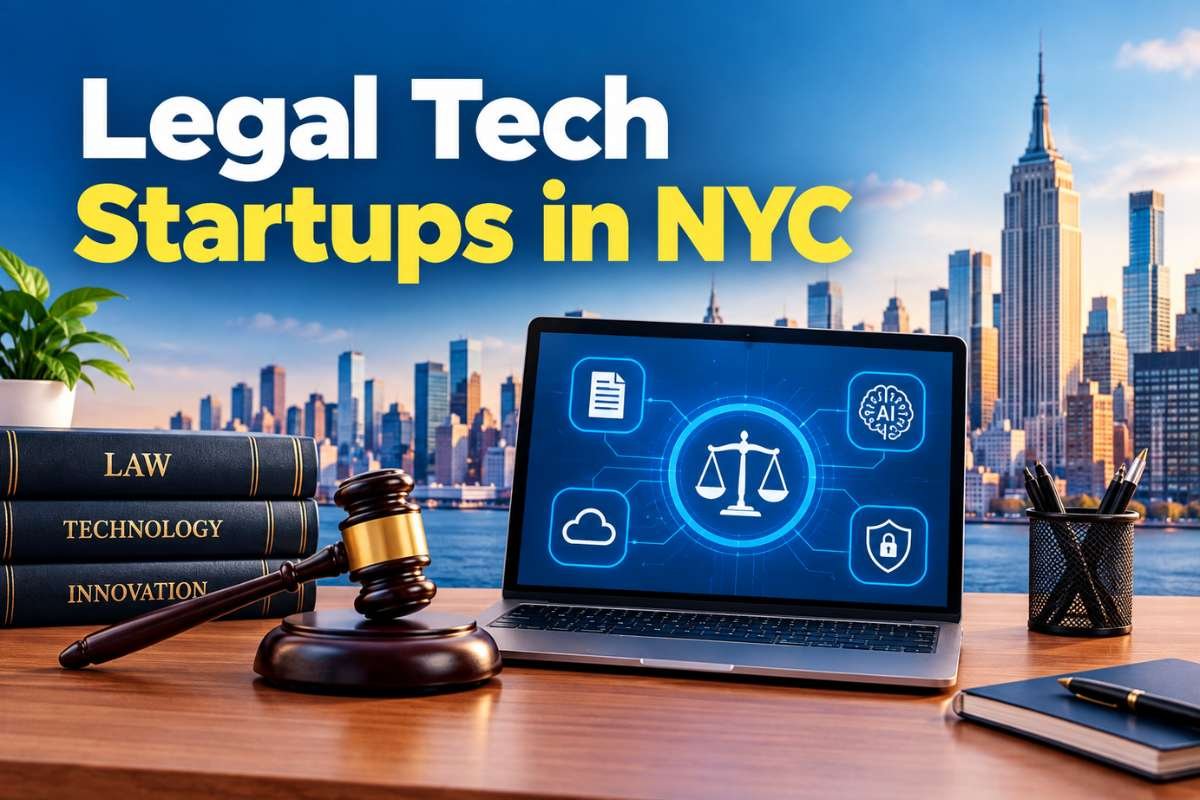
New York has a large legal technology market. The city is home to major law firms, banks, startups, and corporate legal teams. This mix creates many problems that software can help solve. Legal tech startups in NYC now work across contracts, legal research, patents, compliance, and litigation.
AI is also changing how these companies build and sell their products. Some startups focus on one legal task while others aim to manage a wider set of legal work. For investors and founders, this creates several models to watch. The 10 companies below show where NYC legal tech is heading and how startups are tackling costly legal work.
Which Legal Tech Startups in NYC Should Investors Know?
We selected these companies based on their NYC presence, legal technology focus, market relevance, funding activity, and customer base. The list also considers the legal problem each company solves and its use of AI or other technology. GenAI use among legal professionals rose from 14% in 2024 to 26% in 2025, showing the growing demand. The list is especially useful for investors, founders, and business professionals tracking this market.
10 Legal Tech Startups in NYC
1. Harvey
Harvey builds AI tools for law firms and corporate legal teams. As one of the legal tech startups in NYC, its platform helps with research, drafting, review, and other legal work. The company has a strong link to New York’s legal market. It works with major law firms and corporate teams. Harvey is also moving into AI agents that can handle several steps in a task. In September 2026, it raised $550 million at a $15.5 billion valuation.
- Founded: 2022
- Technology Used: Legal AI models, AI agents, workflow automation
- Total Funding: $1.77 billion
- Key Investors: Diffusion, Lightspeed, Sequoia, Kleiner Perkins, a16z, Coatue
2. Norm Ai
Norm Ai combines AI agents with legal experts. Its platform helps businesses handle legal and compliance work. The company also runs Norm Law, an AI-based law firm. Lawyers oversee the AI agents and help improve their work. This model focuses on delivering legal services, not only selling software. Its $120 million Series C in July 2026 valued the company at $1.2 billion.
- Founded: 2023
- Technology Used: AI agents, legal automation, human-AI workflows
- Total Funding: $260 million
- Key Investors: Khosla Ventures, Blackstone, Bain Capital Ventures, Craft Ventures, Coatue
3. Legora
Legora builds an AI platform for lawyers. It helps teams research, review documents, draft work, and manage legal tasks. The company was founded in Sweden but now has a major U.S. base in New York. This makes Legora one of the legal tech startups in NYC with international roots. It opened its first U.S. office there in 2025. Legora raised $550 million in Series D funding in March 2026.
- Founded: 2023
- Technology Used: Generative AI, legal research, workflow automation
- Total Funding: $866 million
- Key Investors: Accel, Benchmark, Bessemer, General Catalyst, ICONIQ, Redpoint
4. Crosby

Crosby is building an AI-powered law firm for growing businesses. It combines AI agents with licensed lawyers to review and negotiate contracts. Its New York base gives it access to startups, technology firms, and other business clients. Crosby aims to solve a common problem: slow contract review can delay sales and deals. The company raised $60 million in Series B funding in March 2026.
- Founded: 2024
- Technology Used: AI agents, contract review, negotiation tools
- Total Funding: $85.8 million
- Key Investors: Lux Capital, Index Ventures, Sequoia, 01 Advisors, Bain Capital Ventures
5. Patlytics
Among legal tech startups in NYC, Patlytics stands out for its focus on patents and intellectual property. Its platform helps with patent searches, drafting, and portfolio management. The New York startup serves companies, IP teams, and law firms. This narrow focus gives it a clear legal workflow to automate. Patlytics raised $40 million in Series B funding in April 2026.
- Founded: 2024
- Technology Used: Patent AI, search, claim analysis, IP workflow tools
- Total Funding: $65 million
- Key Investors: SignalFire, N47, Myriad Venture Partners, Relativity, Alumni Ventures
6. Darrow
Darrow uses AI to find legal risks in large sets of public data. It helps plaintiff law firms find and assess possible cases. Its headquarters are in New York City. The platform can also help firms assess case value and manage litigation work. Darrow raised a Series C extension round in 2025.
- Founded: 2020
- Technology Used: AI, legal intelligence, data analysis
- Total Funding: $78.68 million
- Key Investors: Georgian, NFX, F2 Venture Capital, Entrée Capital, Y Combinator
7. DraftWise
DraftWise builds AI tools for contract work. Its software helps lawyers draft, review, and negotiate legal documents. It uses a firm’s past contracts and legal knowledge to support new work. This can help teams use their own standards across many deals. DraftWise is based in Brooklyn, New York. DraftWise’s most recent funding round is Series A from 2024.
- Founded: 2020
- Technology Used: Generative AI, contract intelligence, legal knowledge systems
- Total Funding: $25.2 million
- Key Investors: Index Ventures, Y Combinator, Earlybird, Bek Ventures
Learn More: 25 NYC Startups Everyone Will Be Talking About in 2027
8. Priori
Priori operates a legal services marketplace for corporate legal teams. Its platform helps companies find outside lawyers for specific legal work. It also helps teams manage outside counsel and legal spend. The New York company focuses on a common in-house problem: finding the right lawyer for a specific need. Priori has also built an advisory group with legal leaders from firms such as Mastercard, Google, Meta, and Capital One.
- Founded: 2013
- Technology Used: Legal marketplace, data matching, legal operations software
- Total Funding: $21.3 million
- Key Investors: Thomson Reuters Ventures, HearstLab, The LegalTech Fund, Eagle Proprietary Investments
9. Hadrius
Hadrius builds compliance software for financial firms. Its platform helps review communications, marketing, trading activity, and other data. The New York company targets regulated financial firms that face large amounts of compliance work. Its AI-based system brings these tasks into one workflow. Hadrius announced $27 million in combined seed and Series A funding in July 2026. It said more than 500 financial institutions already use its platform.
- Founded: 2023
- Technology Used: AI agents, compliance automation, data monitoring
- Total Funding: $27 million
- Key Investors: CRV, Y Combinator, Pathlight Ventures
10. Discernis

Discernis builds AI software for litigation and investigations. Its system reads large document collections and finds evidence across them. For investors tracking legal tech startups in NYC, the company offers a focused approach to AI-powered document review. Discernis is based in New York and is used by Am Law firms. In August 2026, it raised a $2.5 million seed round.
- Founded: 2024
- Technology Used: AI document review, full-collection analysis, private AI deployment
- Total Funding: $2.65 million
- Key Investors: Newfund Capital, Triple Impact Capital, Remarkable Ventures, C2 Ventures
What Should Investors Look for in Legal Tech Startups in NYC?
Investors should look beyond the AI label when reviewing NYC legal tech startups. A strong product should solve a clear legal problem and show measurable value.
“We are looking for growth markets where you are dealing with customers who value technology,” said David Sneddon, an investor interviewed by Legal IT Insider. He also highlighted the importance of the management team and its ability to execute.
Investors can focus on these key factors:
1. A Clear Legal Task
Startups with a focused use case can be easier to understand. Contract review, patent work, discovery, and compliance all have clear users and tasks.
2. Strong Customer Access
Legal tech startups in NYC have access to major law firms, banks, and corporate legal teams. Investors should check whether that access leads to paid customers and repeat sales.
3. A Real Technology Edge
Basic AI tools are now easy to build. Stronger products may use private data, legal workflows, special models, or deep integrations to create an edge.
4. Trust and Human Review
Legal work involves private data and high stakes. Investors should look for strong security, clear audit trails, human review, and controls against wrong AI answers.
5. Room to Expand
A startup may start with one task and later add nearby services. For example, contract review could expand into contract management.
6. Proof from Customers
Funding is only one signal. Investors should also review revenue, customer growth, retention, usage, sales cycles, and clear savings in time or cost.
This matters as competition in legal tech grows. The number of AI tools tracked by Legaltech Hub has grown more than 30% year over year, passing 1,100 companies in 2026.
Major AI firms are also entering the market, with OpenAI, Google, Anthropic, and Thomson Reuters all developing legal AI products. This makes product focus, customer value, and clear differentiation more important for startups.
More Info: Top 10 Tech startups in NYC that are quietly shaping the future of business
Conclusion
The current group of legal tech startups in NYC shows a market moving beyond basic legal search. Startups now target contracts, patents, litigation, compliance, research, and legal services.
For investors, this creates several business models to study. For founders, it shows the value of solving one clear legal problem first. Strong products can then expand into nearby workflows. Customer trust, data security, useful AI, and clear business value will remain key factors as the market grows.
FAQs
1. What is legal tech?
Legal tech is software that helps lawyers, legal teams, or clients handle legal work.
2. Why is NYC important for legal tech?
NYC has major law firms, financial firms, corporate legal teams, investors, and technology talent in one market.
3. Which areas of legal tech are growing?
AI-powered research, contract work, patent analysis, litigation, compliance, and legal services are active areas.
4. How do legal tech startups in NYC make money?
Most use software subscriptions, enterprise contracts, legal service fees, or marketplace fees.
5. What should founders consider when building legal tech?
Founders should focus on a clear legal problem, strong data controls, useful AI, and measurable customer value.
Sources: