
To raise seed funding in New York, founders need a tight pitch, a target list of local VCs and state programs, and a structured outreach process. This guide walks through exactly how to raise seed funding in New York. Everything from building your deck to using non-dilutive city programs most founders overlook is covered. Follow it, and you’ll approach investors with a clearer plan, close faster, and negotiate from a stronger position.
New York’s tech ecosystem now ranks as the second-largest startup hub in the country, behind only Silicon Valley. Yet plenty of founders who move here assume proximity to investors is enough. In reality, success depends on having the right investors, documents, and timing.
If you’re wondering how to raise seed funding in New York, the good news is that the city has more capital. It has more programs and investors than almost anywhere outside Silicon Valley. The challenge is knowing where to look and how to present yourself once you get in the room. This guide breaks down exactly how to raise seed funding, from building your pitch to closing the round.
How to raise seed funding in New York: the step-by-step process
New York investors tend to move a little slower than their West Coast counterparts, but they also bring something valuable. They offer deep industry connections in finance, media, real estate, and healthcare.
Many New York seed funds only invest in companies based in the city, which means your address can actually work in your favor. This local bias is one reason the process of how to raise seed funding in New York looks different from Austin or Miami, where funds are less territorial.
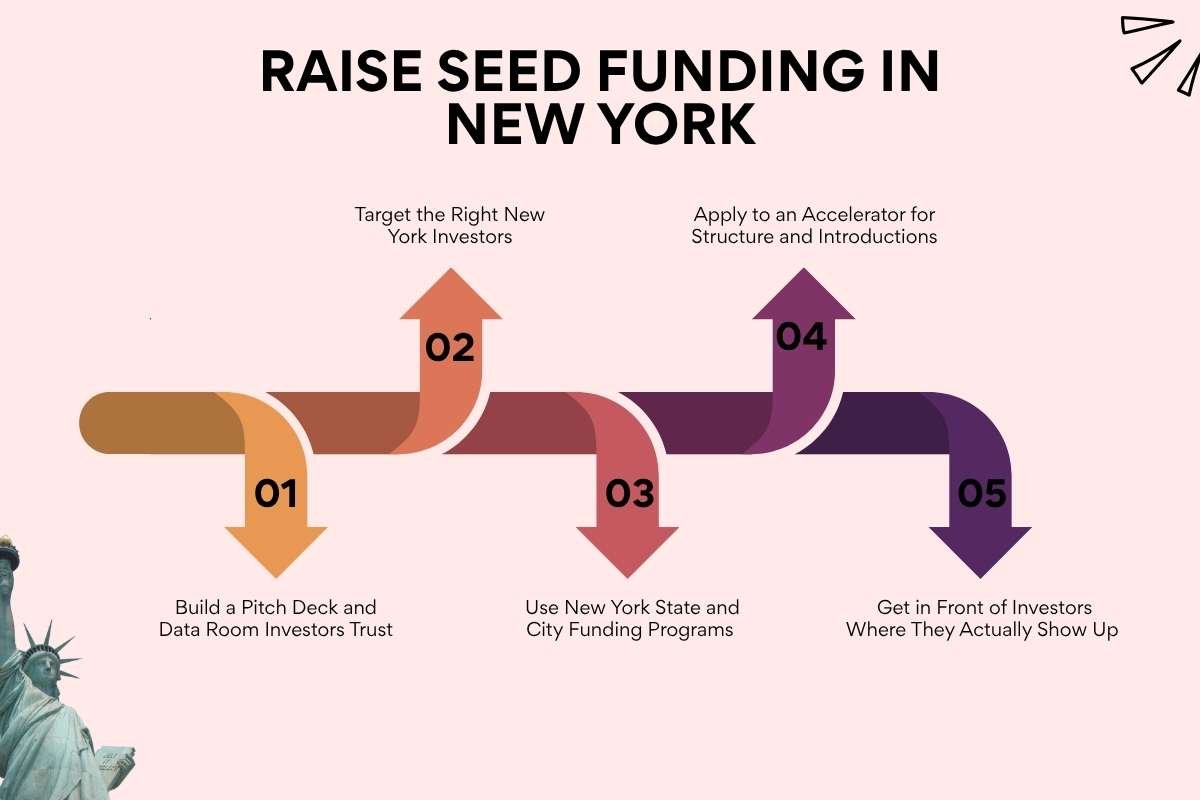
Step 1: Build a pitch deck and data room investors trust
Before you approach a single investor, have your materials ready. A strong seed deck usually runs 10 to 14 slides and covers the problem. It has your solution, market size, traction, team, and the task. Skip the 40-slide version; investors decide whether to take a second meeting within the first few slides.
Alongside the deck, prepare a simple data room with:
- Cap table
- Financial model (even a basic one)
- Customer or user metrics
- Any signed letters of intent or pilot agreements
Founders who show up organized tend to move faster through New York’s investor process. It signals you’ll be just as organized once the check clears. This step alone separates founders who understand how to raise seed funding in New York from those still learning the ropes.
Step 2: Target the right New York investors
New York has a wide bench of seed-stage investors who write checks specifically for local founders. Here’s a snapshot of who to research first.
| Investor Type | Examples | What They Look For |
| City-focused VC funds | Primary Venture Partners, Lerer Hippeau | NYC-based teams, early traction, consumer or B2B products |
| Angel networks | NY Angels, Golden Seeds | Early-stage companies, often pre-revenue |
| State-backed capital | NY Ventures (Empire State Development) | Tech companies willing to grow jobs in New York State |
| Seed-focused nonprofits | NYC Seed | Seed-stage tech founders building an initial product |
| Accelerator funds | Entrepreneurs Roundtable Accelerator (ERA) | Early teams open to a structured program and mentorship |
Primary Venture Partners, for example, used to invest exclusively in New York City companies earlier. That kind of local focus is common here, so don’t overlook funds that seem “small” on paper. Many of them have outsized networks in the city.
Step 3: Use New York state and city funding programs
This is the part many founders skip, and it’s a mistake. New York State runs the Pre-Seed and Seed Matching Fund Program through Empire State Development. It offers equity investments from $50,000 to $250,000 that require a matching private investment. It’s aimed at high-growth tech companies, with extra weight given to founders from underserved regions or backgrounds.
The city also has smaller, more targeted resources:
- NYC Seed invests up to $200,000 in seed-stage tech founders and connects them with mentors and later-stage investors.
- Business plan competitions, like the New York StartUP! Business Plan Competition, award cash prizes between $7,500 and $15,000 and don’t require you to give up equity.
- SBA-backed loans through New York-based lenders can supplement equity funding for companies with revenue already coming in.
None of these alone will fully fund your round, but stacking two or three of them can extend your runway before you even talk to a VC. Many guides on how to raise seed funding in New York skip this step entirely, which is a missed opportunity for non-dilutive cash.
Step 4: Apply to an accelerator for structure and introductions
If you’re new to fundraising, an accelerator can shortcut a lot of trial and error. Programs like the Entrepreneurs Roundtable Accelerator run structured fundraising sessions covering cap tables. They also cover investor targeting, pitch practice, ending in a Demo Day where you present directly to a room of investors.
Accelerator checks are usually modest, often between $50,000 and $150,000, but the real value is the network and the credibility of finishing the program. Founders who go through an accelerator here often close out the rest of their seed round within a few months of Demo Day. This makes accelerators one of the fastest ways to learn how to raise seed funding in New York without a strong existing network.
Step 5: Get in front of investors where they actually show up
Cold emails work occasionally. Warm introductions work far more often. New York has a packed calendar of founder meetups, pitch nights, and investor office hours across coworking spaces and universities like NYU and Columbia. Showing up consistently, even before you’re raising, builds the relationships that make your eventual outreach land differently.
Warm introductions can make a meaningful difference. Amy Nelson, founder of The Riveter, told Y Combinator that she became “super methodical” about fundraising by identifying target investors and finding people in her network who could make introductions.
A short, specific update email sent monthly to a handful of investors you’ve met keeps you on their radar without asking for anything. By the time you’re ready to raise, several of them already know your name, and that groundwork is the real answer to how to raise seed funding in New York faster than founders who start cold.
How much money should you raise?

Seed rounds in NYC have grown larger in 2026. In the first half of the year, more than 240 NYC startups raised at least $1.13 billion in seed funding, with the average round reaching $6.64 million, up from $5.4 million in H1 2025. AI and enterprise software startups accounted for roughly 45% of the capital raised.
Before you set a target number, work backward from your milestones:
- What do you need to prove to raise a Series A in 18 to 24 months?
- How many people do you need to hire to hit that milestone?
- What does 18 months of runway actually cost, including a buffer for slower months?
A round sized around a real plan is easier to defend in a pitch meeting.
How long does the process actually take?
A seed fundraising process can take several months from preparation through closing, although the active investor process may be much shorter. First Round Capital estimates that a well-run fundraising process can take about four to eight weeks, with preparation and closing adding additional time.
A typical process may look like:
- Weeks 1–4: Build your investor list, refine your deck and begin outreach.
- Weeks 4–10: Hold first meetings, gather feedback and refine the pitch.
- Weeks 8–16: Advance interested investors through follow-up meetings and negotiate terms.
- Final stage: Complete due diligence, legal documents and closing.
The exact timeline varies by company, investor interest, traction and market conditions. Running conversations in parallel can help founders maintain momentum rather than extending the process through sequential investor meetings.
Common mistakes when practicing how to raise seed funding in New York

The fundraising market is becoming more selective. U.S. pre-seed and seed deals in the $200,000 to under-$5 million range fell roughly 20% year over year. This highlights why founders need a focused investor strategy. Even founders who understand how to raise seed funding in New York in theory still trip over a handful of avoidable errors.
- Raising too little: Underestimating runway forces a rushed follow-up round.
- Pitching too broadly: Investors want a specific answer to “why now” and “why you.”
- Ignoring state and city programs: Free or non-dilutive capital is easy to overlook when you’re focused on VCs.
- Skipping the follow-up: Many rounds close because a founder followed up consistently, not because the first pitch was perfect.
Final thoughts
Learning how to raise seed funding in New York comes down to combining the city’s dense investor network with the state and city programs most founders never research. Make a tight ten-slide deck and a target list that mixes VCs like Primary Venture Partners with public programs like NY Ventures. Apply for the NY StartUP! competition or an ERA cohort while pitching investors.
Treat first meetings as the start of a relationship, not a pitch to win on the spot. Send monthly updates and follow up even after a no. Founders who run this parallel process, instead of chasing one investor at a time, tend to close faster and on terms they actually chose.
FAQs
1. What seed funding programs are available in New York?
New York offers programs like the NY Ventures Pre-Seed and Seed Matching Fund, NYC Seed, and the NY StartUP! Business Plan Competition, alongside accelerators like ERA.
2. How do I find seed investors in NYC?
Start with city-focused VC firms like Primary Venture Partners and Lerer Hippeau. Join angel networks like NY Angels, and attend founder meetups where investors regularly show up.
3. How much seed funding can a New York startup raise?
Seed rounds vary widely, but most New York startups raise enough to cover 18 to 24 months of runway.
4. How long does it take to raise seed funding?
It can take several months, depending on traction, investor interest, due diligence, and deal terms.
5. Who qualifies for seed funding?
Startups typically need a strong team and evidence of potential, such as a working product, early users, or initial revenue.
Sources: