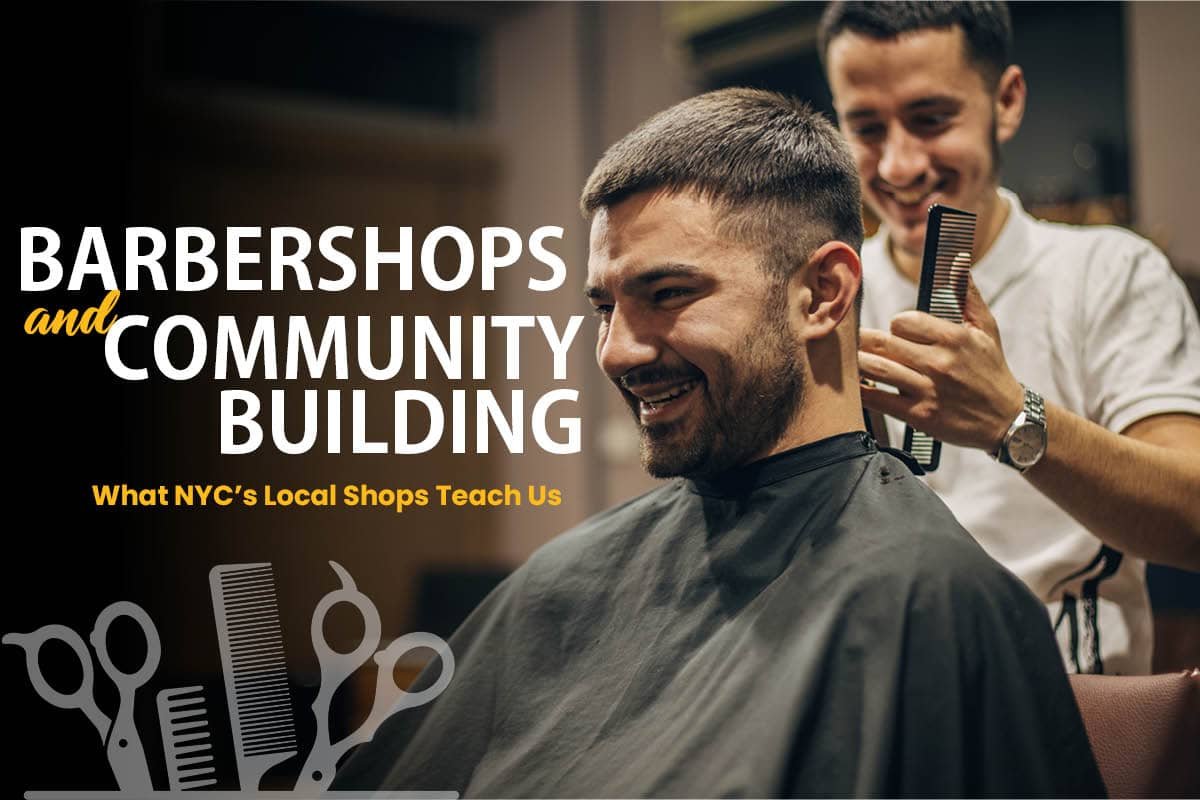
It’s a little past 9 a.m. on a side street in the city, and the barbershop door is already propped open. A kid is getting his first fade. An older regular is in the chair next to him, mid-story, and three more are waiting on a bench by the window, not checking their phones, just talking. Nobody’s in a rush. This is the kind of scene you can find on almost any block in New York, and it’s also the easiest way to understand barbershops and community building: not as an abstract idea, but as something that happens quietly and reliably every single day.
It’s easy to think of a barbershop as a transaction: you walk in, you get a haircut, you leave. But anyone who’s spent real time in one knows that’s not the whole story. The chair is often where people talk about their week, their kids, their plans, their problems. The barbershop becomes a fixture in a neighborhood’s daily rhythm, and that rhythm is exactly what barbershops and community building are about.
The “Third Place” Theory Behind Barbershop Community
There’s actual sociology behind this feeling, and it’s worth knowing because it explains why barbershops matter more than most people assume. In 1989, sociologist Ray Oldenburg introduced the concept of the “third place” in his book The Great Good Place. His argument: people need more than just a first place (home) and a second place (work). They need a third place somewhere informal, low-pressure, and recurring, where familiar faces gather without an agenda. Cafés, bars, and barbershops are the classic examples.
Barbershops fit this role almost perfectly. They’re public enough that anyone can walk in, but personal enough that regulars are known by name. You go back to the same chair, the same barber, often the same time slot every few weeks, and that repetition is what builds what researchers call “place attachment,” the bond between a person and a location. This is the foundation of barbershops and community building: not a single visit, but years of small, repeated interactions that add up to real trust.
This is also the role of barbershops in communities that doesn’t show up on a receipt. A 2023 study on third places found that neighborhoods with more of them, including bodegas, barbershops, parks, and local shops, reported higher levels of interaction between neighbors and stronger overall cohesion, with the effect strongest in lower-income areas. Research suggests that third places can strengthen neighborhood interaction and cohesion, which may contribute to informal forms of social support and public safety.
How Barbershops Build Community: A History Rooted in Ownership
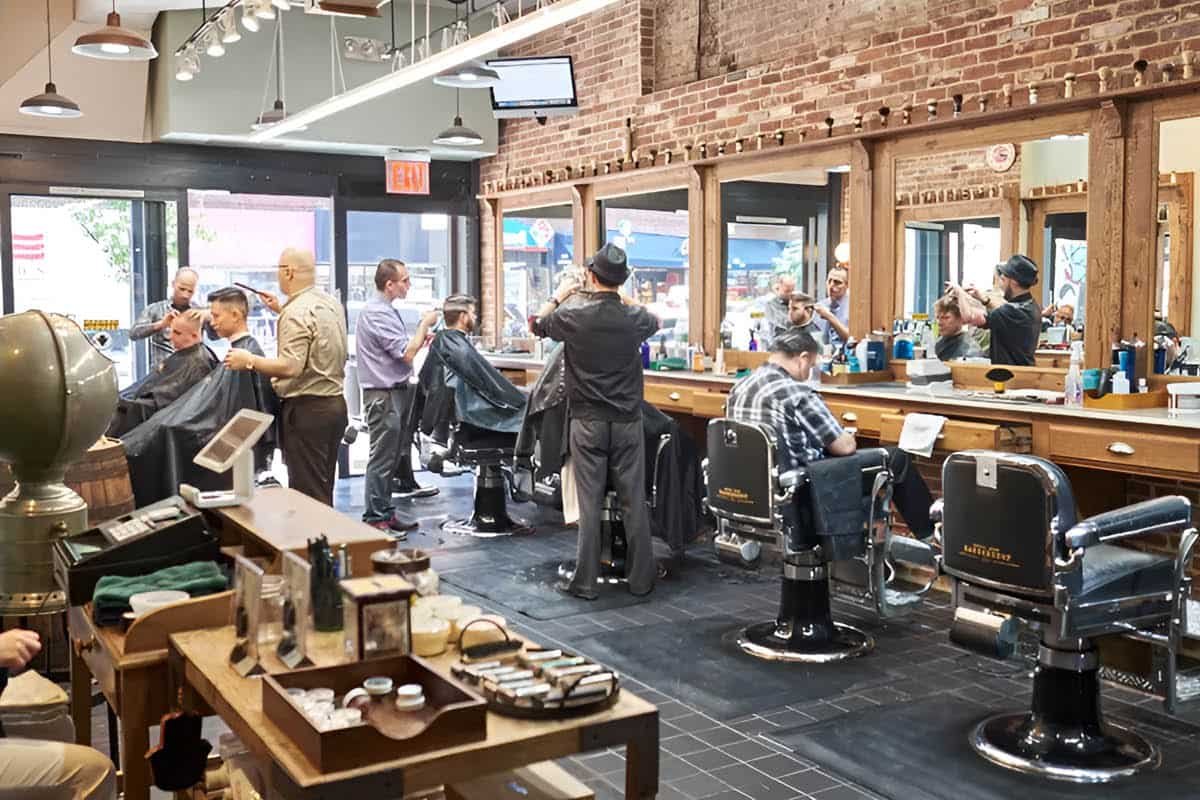
Barbershops and community building isn’t a new trend dressed up for a magazine feature; it has deep roots, particularly in Black communities across the country. Historically, the barbershop was often one of the first places where Black entrepreneurship could take hold, at a time when access to capital and ownership elsewhere was limited. A barber didn’t need a storefront on a major avenue or outside investors just skill, a chair, and a community willing to show up.
That made barbershops some of the earliest examples of small business ownership passed down block by block, and that legacy still shapes how barbershop community functions today: these are often family-run, multigenerational businesses where the owner knows three generations of the same family.
That history matters for understanding why barbershops became more than service businesses. They were and remain spaces where people could speak freely, build credibility, and rely on each other, long before “community building” was a phrase anyone used on purpose.
A Closer Look
New York offers some of the clearest, most documented examples of this in the country. Take House’s Barbershop in Harlem, which operated for more than 55 years and became such a fixture of the neighborhood that photographer Jeffrey Henson Scales spent five years, from 1986 to 1992, documenting its work, later published as the monograph House and exhibited at Claire Oliver Gallery. The photographs reveal it as more than a business: they capture regulars, rituals, and intergenerational connections inside the shop.
A few blocks over in East Harlem, Claudio’s Barbershop told a similar story from a different angle. The shop opened during World War I, and Claudio himself worked there from the 1950s until it closed in 2019, more than 60 years at the same chair. It was for simply staying, decade after decade, as one of the few constants on a block that changed around him.
This kind of staying power is central to barbershops and community building in a city like New York, where storefronts turn over constantly. Historians have taken the pattern seriously, too. Quincy Mills, a historian at Vassar College who studies African American urban and business history, has researched how Black barbershops in Harlem and Bedford-Stuyvesant functioned as public forums, spaces where men could socialize, debate, and organize outside the reach of formal institutions. The shops weren’t just witnesses to neighborhood history; they were where some of it happened.
That’s the throughline connecting House’s, Claudio’s, and the thousands of smaller shops still cutting hair across the five boroughs today: local barbershops and community aren’t a side effect of the business. In New York, they’re often the reason the business survives at all.
Barbershops and Community Building Beyond the Haircut
If the historical case feels abstract, the health research makes the same point in very concrete terms. One of the most striking examples of barbershop community in action comes from a study published in the New England Journal of Medicine. Researchers recruited 319 Black male patrons with uncontrolled high blood pressure from 52 Black-owned barbershops across Los Angeles County. At half the shops, barbers encouraged customers to meet with specially trained pharmacists, on-site, to manage their blood pressure medication. At the other half, customers were simply encouraged to see their own doctors.
The results were dramatic. Within six months, 63.6% of men in the pharmacist-led, barbershop-based program had their blood pressure under control compared to just 11.7% in the group that was only encouraged to seek outside care. A year later, the gains held: 68% versus 11%. Health researchers involved noted that barbershops carry something a clinic often can’t: an existing relationship of trust, especially relevant given that many Black patients report distrust of the broader healthcare system.
The barbershop didn’t just cut hair; it became the entry point to actual medical care that people were far more likely to accept. A barber isn’t a doctor, but the existing relationship between barber and customer can create an unusually accessible setting for health interventions.
What Local Barbershops and Community Look Like in NYC Today
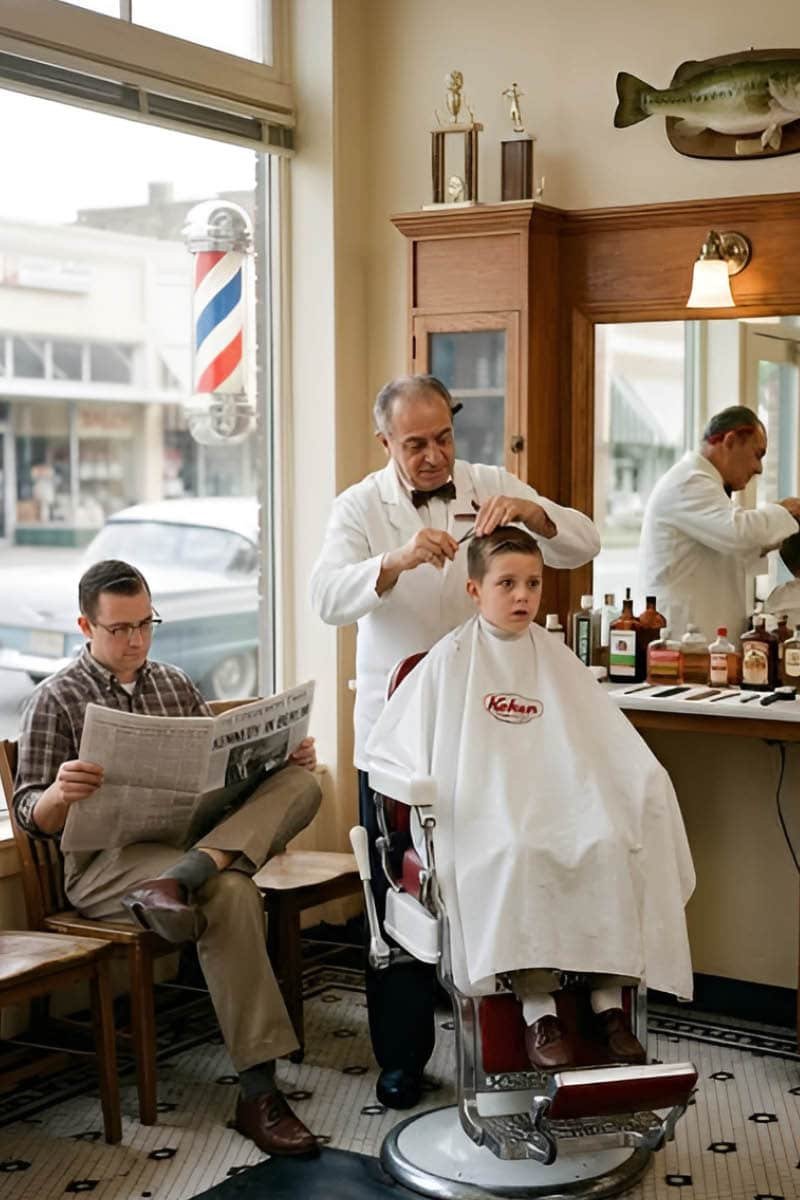
Walk through almost any New York neighborhood, and you’ll see this playing out in real time. The barbershop is often one of the few remaining local institutions that a chain hasn’t replaced; it’s still independently owned, still run by someone whose name customers actually know. In a city defined by turnover, where storefronts change every few years, a barbershop that’s been on the same corner for a decade earns a different kind of credibility. It becomes a landmark.
That’s really the throughline of barbershops and community building: it isn’t built through marketing or events; it’s built through consistency. The same chair, the same conversations, the same willingness to let people linger a little longer than the haircut requires. It shows up in small ways: a barber who remembers a customer just started a new job, or asks about a kid’s school year, and in bigger ones, like neighbors meeting each other for the first time on a bench by the window.
Why Community Is Good Business
For a neighborhood barbershop, community is not just something that happens around the business. It can become part of the business model itself. A customer who trusts a barber is less likely to choose another shop simply because it offers a slightly cheaper haircut. Familiarity creates a reason to return, and that matters in a business built around recurring appointments.
This is where barbershops and community building have a clear commercial advantage. A regular customer may return every few weeks, recommend the barber to a friend, bring in a child, and eventually introduce another generation of the family to the same shop. Over time, one relationship can become a steady stream of repeat business. Word-of-mouth referrals also carry a different kind of credibility from advertising because they come from people who already know the neighborhood and the business.
That loyalty creates something particularly valuable for local businesses: predictability. Regular customers make appointment cycles easier to anticipate, while a strong neighborhood reputation can help a shop remain resilient even when competitors enter the market or prices fluctuate. The result is a business that competes on more than price.
More Info: How Locals Are Turning Small Business Opportunities in Queens Into Cash
The Takeaway
The lesson extends beyond hair. Local businesses become part of a neighborhood when people return often enough to become familiar, when owners know their customers, and when the space gives people a reason to stay. In a city as large and fast-moving as New York, that kind of familiarity has real value.
Other neighborhood businesses should pay attention to this example. Loyalty is not always created by discounts, promotions, or convenience. Sometimes it comes from being consistently present, remembering the people who walk through the door, and becoming woven into the routines of the surrounding community.
A barbershop may sell a haircut, but its longevity often comes from everything that happens around the chair. That is perhaps the bigger lesson of barbershops and community building: a local business becomes valuable not only for what it sells, but for the place it creates in people’s everyday lives.