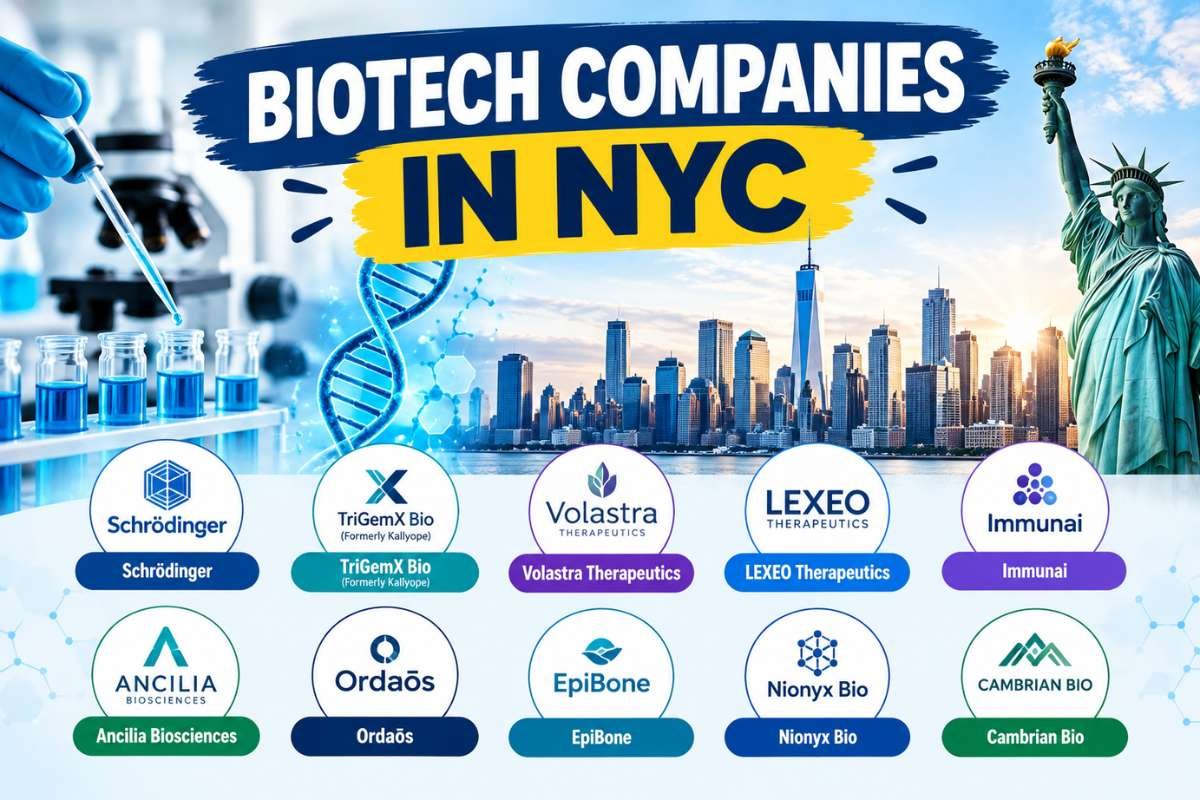
Biotech companies in NYC develop new medicines, research tools, and technologies to tackle health problems. Their work spans cancer, gene therapy, immune science, and drug discovery. Some firms develop treatments, while others build tools that help scientists find better drugs.
New York has a strong base for this work. Its research hospitals, universities, investors, and lab spaces help turn scientific ideas into new businesses. Yet each company faces different scientific, financial, and regulatory hurdles. This guide covers 10 notable firms, their core technologies, key developments, and funding. It also explains why New York is gaining ground as a life sciences hub.
10 Biotech Companies in NYC Pushing the Boundaries of Medicine
New York’s biotech scene covers many fields, from cancer drugs to AI-powered research. The firms below vary in size, funding, and stage of development. Some sell products today, while others are still testing new treatments. Their profiles focus on what each company does, the science behind its work, and its key milestones.
1. Schrödinger
- Founded: 1990
- Core technology: Computer models that help design and study molecules.
Schrödinger builds software that helps scientists predict how molecules behave. Drug teams use its tools to study targets and design new compounds. The company also runs its own drug research programs and works with other drugmakers. Based in New York City, it trades on Nasdaq under SDGR. Its mix of software sales and drug research sets it apart from firms focused only on medicine.
2. TriGemX Bio (Formerly Kallyope)
- Founded: 2015
- Core technology: Small-molecule drug discovery, including TRPM8 channel blockers.
TriGemX Bio is developing elismetrep, an investigational drug for migraine. The treatment targets the TRPM8 channel and entered Phase 3 trials in October 2026. The company was once called Kallyope and studied links between the gut, brain, and metabolism. After selling its obesity programs to Novo Nordisk, it adopted its new name. It also announced $94 million in financing to support its migraine program.
3. Volastra Therapeutics
- Founded: 2019
- Core technology: Cancer drugs that target chromosomal instability.
Volastra develops drugs that target chromosomal instability, a feature found in many cancers. This approach aims to exploit weaknesses in tumor cells. Its pipeline includes KIF18A inhibitors, such as sovilnesib and VLS-1488. The company has raised funding from investors such as ARCH Venture Partners, Polaris Partners, and Lilly. Its work stands out among biotech companies in NYC because it targets a feature of cancer cells instead of a single cancer type.
4. LEXEO Therapeutics
- Founded: 2018
- Core technology: AAV gene therapy for inherited diseases.
LEXEO develops gene therapies for heart and brain conditions. Its lead program, LX2020, targets PKP2-associated arrhythmogenic cardiomyopathy, a genetic heart disease. In August 2026, the FDA granted the treatment Regenerative Medicine Advanced Therapy designation. This status may help speed its development, but it does not mean the treatment is approved. LEXEO has raised major early-stage funding, including an $85 million Series A and a $100 million Series B.
5. Immunai
- Founded: 2018
- Core technology: AI and large datasets for mapping immune cells.
Immunai uses AI to study immune cells and their roles in disease. Its platform helps researchers find drug targets and study how patients may respond to treatment. The company works with drugmakers and research centers. It reports more than 40 partnerships and $295 million in funding. Its backers include KDT and Alexandria Venture Investments. This focus on immune data can help drug teams make better choices during early research.
6. Ancilia Biosciences
- Founded: 2019
- Core technology: CRISPR tools and virus-resistant beneficial bacteria.
Ancilia Biosciences studies how to protect helpful bacteria from viruses. Its technology uses CRISPR, a natural defense system found in bacteria. The company aims to make live bacterial products more stable and useful for health and other uses. It announced a $4.2 million funding round in July 2024, led by Safar Partners. Among biotech companies in NYC, its work differs from firms that focus on human cells or direct drug targets.
7. Ordaōs

- Founded: 2019
- Core technology: Generative AI for designing small therapeutic proteins.
Ordaōs uses AI to design small proteins that bind to chosen targets. Its miniPRO platform aims to help researchers create drug candidates that may be hard to design with older methods. The company combines computer design with lab tests to check each candidate. It announced a $5 million seed round in 2022, led by VTC Ventures. Its approach links AI design with hands-on science to speed early drug research.
8. EpiBone
- Founded: 2013
- Core technology: Stem-cell-based bone and cartilage engineering.
EpiBone develops living bone and cartilage products to repair damaged tissue. It uses cells, medical scans, and special growth systems to make tissue shaped for specific injuries. Its research includes bone grafts for face and skull repair, as well as cartilage products for joint damage. The company has raised about $48.6 million in tracked funding. Its work could offer new options for patients who need tissue repair after injury or surgery.
9. Nionyx Bio
- Founded: 2025
- Core technology: AAV capsids designed to deliver gene therapy to kidney cells.
Nionyx Bio is developing gene therapies for inherited kidney diseases. Its platform tests delivery tools in human kidney tissue to help target the right cells. Its pipeline includes ONYX-101, a treatment for Alport syndrome that remains in preclinical development. The company launched in September 2025 with $4 million in seed funding. Backers included 2048 Ventures and New York Ventures. It focuses on a key challenge: delivering gene therapies to kidney tissue.
10. Cambrian Bio
- Founded: 2019
- Core technology: Drug development focused on the biology of aging.
Cambrian Bio backs research into the causes of age-related disease. It supports several programs through related biotech companies. Its pipeline includes ATX-304, an oral drug studied for obesity and related metabolic problems. Cambrian reported a $100 million Series C in 2021, co-led by Anthos Capital and SALT Fund. Its model spreads research across several programs rather than betting on a single treatment.
These biotech companies in NYC show how different technologies can address unmet medical needs. Some focus on approved medicines, while others are testing early ideas. Their progress depends on strong science, funding, skilled teams, and a clear path to patients.
Read More: Pharmaceutical Companies in New York: A Comprehensive Overview
Why is NYC Emerging as a Biotech Hub?
Biotech companies in NYC benefit from strong research centers, investor support, skilled workers, and new lab space. These resources help turn scientific discoveries into new companies and treatments. The city’s LifeSci NYC initiative has committed more than $1 billion to support life sciences growth.
- Strong Research Institutions: Columbia University, Weill Cornell Medicine, Rockefeller University, and major hospitals support research and train scientists. Their work can lead to new treatments and biotech startups.
- Access to Funding: Venture capital firms, public programs, and pharma partners help fund biotech research. Early-stage firms need seed money, while clinical trials often require larger investments.
- Skilled Talent and Lab Space: NYC draws experts in biology, drug design, and data science. Shared facilities, such as BioLabs at NYU Langone, give startups access to lab space and equipment.
- Industry Partnerships: Biotech firms work with hospitals, universities, and drugmakers to test ideas and develop treatments. These links give biotech companies in NYC access to research, clinical networks, funding, and expert support.
Andrew Baum, Pfizer’s Chief Strategy and Innovation Officer, highlighted the city’s strengths in 2025: “New York is uniquely positioned to lead the next wave of biotech innovation.” He pointed to its research institutions, entrepreneurial drive, and investment as key strengths.
Conclusion
New York’s biotech sector spans cancer care, gene therapy, AI drug design, and tissue repair. Its research centers, hospitals, investors, and lab programs give firms a strong base for growth. Yet each company faces risks tied to science, funding, and clinical results. When checking biotech companies in NYC, look at each firm’s technology, trial stage, partners, and funding. Use these factors to judge its progress and future potential.
FAQs
1. What types of biotech companies are based in NYC?
They work in drug discovery, gene therapy, cancer care, immune science, tissue repair, and microbiome research.
2. Why is NYC attractive to biotech startups?
It offers research hospitals, skilled workers, venture capital, and growing lab space.
3. How do NYC biotech companies raise money?
They use venture capital, grants, pharma deals, public markets, and research partnerships.
4. Are any NYC biotech firms working on gene therapy?
Yes. LEXEO Therapeutics and Nionyx Bio are developing gene therapies for inherited diseases.
5. Which biotech companies in NYC focus on cancer?
Volastra Therapeutics and Syndax Pharmaceuticals develop cancer treatments, while Schrödinger supports drug design.