
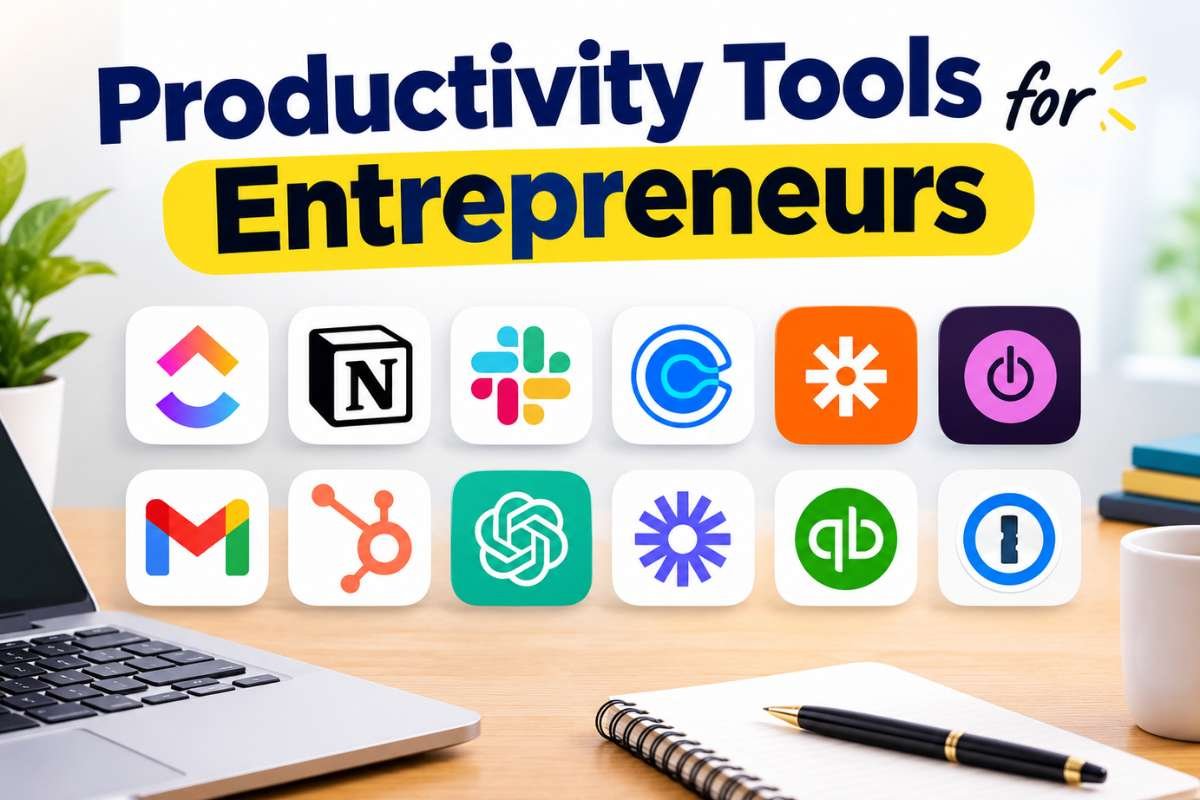
Running a business means switching between big plans and small tasks all day. You may handle sales in the morning, answer team questions at noon, and review cash flow at night. The best productivity tools for entrepreneurs include ClickUp for tasks, Slack for team chat, Calendly for scheduling, and more. These can reduce busywork and keep key work in one place.
But more apps do not always mean more output. A good tool should solve a clear problem, save time, or reduce repeated work. This guide covers tools for tasks, communication, scheduling, automation, and more. It also shows how to build a simple stack that can grow with your business.
12 Productivity Tools for Entrepreneurs to Solve the Biggest Bottlenecks
The best productivity tools depend on where your time goes. A solo founder may need fast task capture, while a growing team may need better project control. A survey of 508 business leaders found that more than half spend at least 30% of their day on busywork, showing why better tools can help reduce time lost to routine tasks.
| Tool | Main job | Best for |
| ClickUp | Project and task management | Small teams and growing startups |
| Notion | Notes, docs, and knowledge | Founders building a central workspace |
| Slack | Team communication | Fast team updates |
| Calendly | Meeting scheduling | Founders with many calls |
| Zapier | Workflow automation | Repetitive admin work |
| Toggl Track | Time tracking | Finding time leaks |
| Google Workspace | Files and collaboration | Everyday business work |
| HubSpot | CRM and sales | Managing leads and follow-ups |
| ChatGPT | AI support | Writing, research, and ideas |
| Loom | Video communication | Replacing simple meetings |
| QuickBooks | Accounting | Business finance and records |
| 1Password | Password management | Secure team access |
1. ClickUp: Manage Tasks and Projects in One Place
ClickUp brings tasks, projects, documents, goals, dashboards, and communication into one workspace. Its current feature set also connects AI with tasks, docs, conversations, and company information.
Best for: Entrepreneurs managing several projects or a small team.
It is one of the best productivity tools for entrepreneurs when tasks are spread across emails, chats, and separate lists. Skip it if you only need a simple personal to-do list.
2. Notion: Build a Company Knowledge Hub
Notion can hold meeting notes, product plans, hiring guides, investor material, and company processes. This makes it useful when important information is scattered across many files.
Best for: Founders who need one searchable place for business knowledge.
The key is to keep the setup simple. A complex workspace can become another task to maintain.
3. Slack: Keep Team Communication Moving
Slack gives teams channels for projects, clients, and internal topics. It can reduce long email chains and make quick questions easier to handle.
Best for: Teams that need frequent communication.
Set clear rules around urgent messages. Otherwise, Slack can become another source of interruptions.
4. Calendly: Remove the Back-and-Forth from Meetings
Calendly lets people book time based on your available slots. This can cut the email exchange that often comes before a sales call, interview, or client meeting.
Best for: Entrepreneurs whose calendars are packed with external calls.
It works best when you also set limits, such as meeting days or fixed call windows.
5. Zapier: Automate Repeat Work
For automation, Zapier is one of the most popular productivity tools for entrepreneurs. It connects different apps so one action can trigger another. For example, a new form entry can create a lead in a CRM and notify the right team member.
Best for: Businesses with repeated admin steps.
Automation has the most value when the task happens often and follows a clear rule. Start with one workflow before automating dozens.
6. Toggl Track: See Where Your Time Goes
Time tracking can show how much of your week goes to sales, admin, meetings, client work, or product work.
Best for: Entrepreneurs who feel busy but cannot see where their hours go.
The goal is not to track every minute forever. Use the data to find patterns and then change the work that consumes too much time.
7. Google Workspace: Handle Everyday Business Work
Google Workspace combines email, documents, spreadsheets, storage, calendars, and collaboration tools. It can serve as the basic work layer for many small businesses.
Best for: Entrepreneurs who need reliable tools for everyday operations.
Its value comes from how well the apps work together, rather than from one standout feature.
8. HubSpot: Organize Leads and Customer Follow-ups
A CRM can prevent sales leads from getting lost in email threads or spreadsheets. HubSpot can help track contacts, deals, follow-ups, and customer activity.
Best for: Entrepreneurs who are building a repeatable sales process.
You may not need a full CRM at the idea stage. It becomes more useful once lead volume or follow-up work starts growing.
9. ChatGPT: Speed Up Thinking and Routine Writing
AI tools can help entrepreneurs draft emails, summarize notes, create outlines, brainstorm ideas, analyze supplied information, and prepare first drafts.
Best for: Founders who handle a high volume of writing or research.
Among productivity tools for entrepreneurs, ChatGPT is the most used. Use AI to speed up routine work, not to remove human review. Business decisions still need context and judgment.
10. Loom: Explain Work Without Another Meeting
Loom lets you record your screen and voice to explain a process, product issue, or task. A short video can sometimes replace a meeting that would take much longer.
Best for: Remote teams and founders who explain the same things often.
Keep recordings short and give them clear titles. Otherwise, your video library can become hard to search.
11. QuickBooks: Reduce Finance Admin
Accounting software can help track income, expenses, invoices, and other financial records. It gives entrepreneurs a clearer view of routine business finances.
Best for: Small businesses that need organized financial records.
Use professional accounting help when tax rules, payroll, or complex reporting require it.
12. 1Password: Protect Access as the Team Grows
Password management becomes harder when founders share access across multiple services. A password manager can keep credentials organized while reducing unsafe password sharing.
Best for: Businesses with several online accounts and team members.
Set access rules early, especially for tools that contain customer, financial, or business data.
How Should Entrepreneurs Choose Productivity Tools?
A common mistake when choosing productivity tools for entrepreneurs is focusing only on features. A better approach is to start with the business problem.
Ask these five questions:
- What problem happens every week? Choose a tool for a repeated pain point.
- How much time does it cost now? Focus first on tasks that consume many hours.
- Who needs to use it? A solo tool may not work for a growing team.
- Does it connect to your current stack? Good integrations can prevent duplicate data entry.
- Will you still need it as the business grows? Avoid tools that create costly migrations later.
Thomas Hansen, former Worldwide Vice President of Small and Medium Businesses at Microsoft, advises entrepreneurs to avoid spending too much time optimizing their technology. His advice is simple: “nothing beats commitment, clarity and focus.”
Use the One-Tool-Per-Job Rule
Start with one main tool for each major job:
Capture → Organize → Communicate → Automate → Measure
For example, you could use a task manager for work, Notion for knowledge, Slack for team chat, Zapier for automation, and Toggl Track for time data. This approach also helps prevent app overlap. Matching tools to specific jobs is important rather than simply collecting more apps.
How to Build a Productivity Stack That Scales?
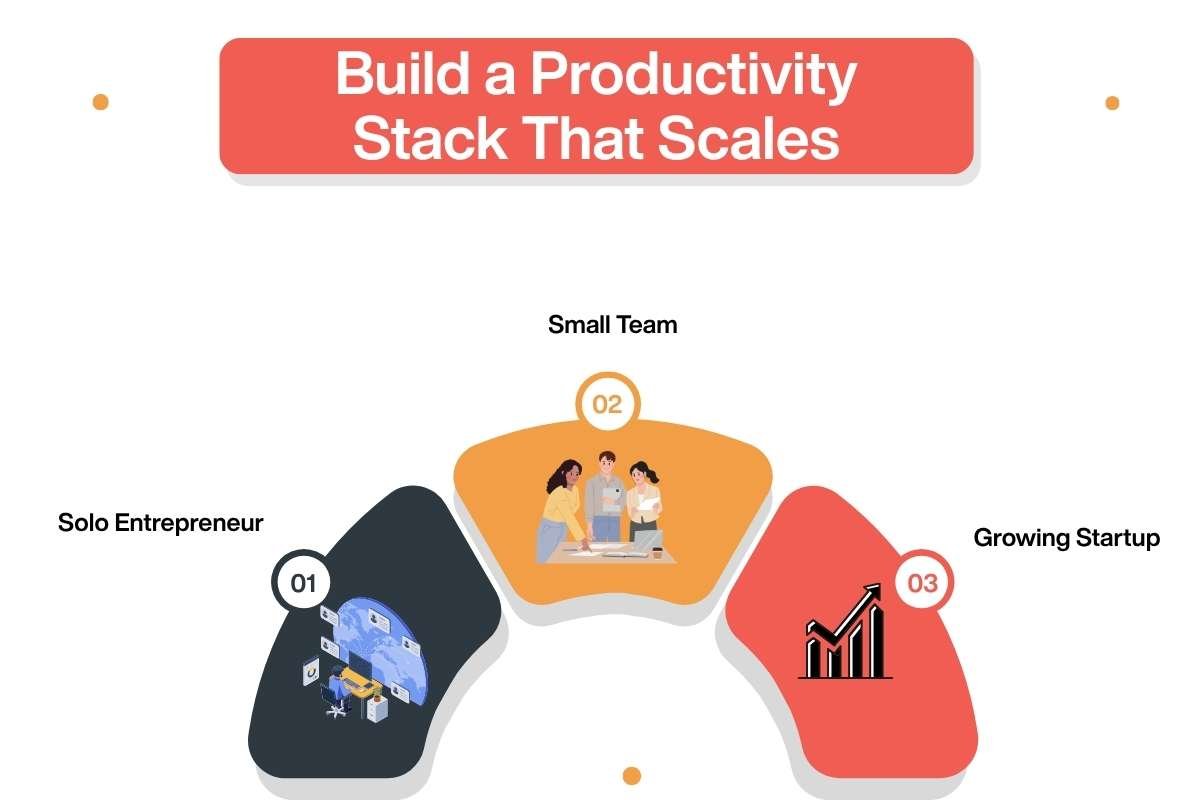
Productivity tools for entrepreneurs should change as your workload changes. A solo founder does not need the same stack as a 30-person company.
Solo Entrepreneur
Keep the stack light: task manager + calendar + notes and documents + AI assistant + accounting tool. The goal is fast capture and low maintenance.
Small Team
Add tools for: project ownership + team communication + customer tracking + workflow automation + shared knowledge. At this stage, clear ownership matters more. Every major task should have a person responsible for moving it forward.
Growing Startup
A larger team may need: project and product management + CRM + finance systems + automated workflows + access and security controls + company knowledge management. Do not add all productivity tools for entrepreneurs at once. Add them when a real business need appears.
When Should You Replace or Remove a Productivity Tool?
A tool may have been useful when the business was smaller but created friction later. A survey says that businesses spend 25 hours per week on manual data entry or reconciling data across apps. They also overspend an average of $3,000 per month on unused software.
Watch for these signs:
- Employees keep information in different systems.
- The same data is entered more than once.
- People need several apps to complete one basic task.
- You spend more time managing the tool than using it.
- The tool no longer supports your team size.
- Important work depends on one person’s personal account.
A quarterly tool audit can help. List every paid app, its users, its main purpose, and whether it still saves meaningful time.
Conclusion
The best productivity tools for entrepreneurs are not always the tools with the most features. They are the ones that remove a real source of friction from your workday.
First, understand your biggest bottleneck. If tasks are scattered, fix task management. If meetings consume your week, improve scheduling. If admin work repeats, automate it. Build your stack one problem at a time, then adjust it as your business grows.
FAQs
1. What are the best productivity tools for entrepreneurs?
The right tools depend on whether your main need is task management, communication, automation, sales, finance, or time tracking.
2. How many productivity tools should an entrepreneur use?
Use the smallest stack that covers your core business needs without creating duplicate work.
3. Are productivity tools worth paying for?
They can be worthwhile when the time or errors they reduce are greater than their cost.
4. What is the best productivity tool for a small business?
A project or task tool is often a useful starting point because it gives work clear owners and deadlines.
5. How can entrepreneurs avoid tool overload?
Choose one primary tool for each job and review your software stack every few months.