
New York City is experiencing a massive office leasing boom driven by expanding tech and AI companies. This post examines the changing commercial real estate market NYC, explaining why luxury brands buy storefronts and how building values are split. Readers will gain a simple breakdown of 2026 market metrics and a professional investing checklist.
Companies are rushing to rent offices in New York City again! Tech giants, artificial intelligence (AI) startups, and law firms are signing massive deals. In early 2026, businesses rented 9.5 million square feet of space in just three months. That is the highest number the city has seen since 2014.
Meanwhile, famous fashion brands are stopping their traditional rental models. Instead, they are spending billions of dollars to buy their flagship storefronts outright.
Old, run-down buildings are losing value fast, but shiny new skyscrapers are breaking records. Some spaces now cost over $300 per square foot to rent. This dramatic split shows that the Commercial Real Estate Market NYC is moving through a massive “flight-to-quality” shift. Think of it like trading a clunky, old foot-scooter for a sleek new electric scooter. Everyone wants the best option available.
What Do the Official 2026 Numbers Reveal About the Market?
To truly understand the commercial real estate market in NYC, you must separate the data by sector. If you mix beautiful new towers with old, dark buildings, the math lies to you. New skyscrapers have long waiting lists. Old buildings sit empty. Think of it like empty seats on a school bus. If a bus has a high “vacancy rate,” it simply means lots of seats are empty.
The official first-quarter reports for 2026 show exactly how each specific property sector performs in the Commercial Real Estate Market NYC:
| Real Estate Sector | Vacancy Rate (Empty Seats) | Average Asking Rent (Per Sq. Ft.) | Current Core Industry Trend |
| Manhattan Office (All Classes) | 19.9% (Lowest since 2021) | $73.13 | Tech and AI firms expand their physical office sizes. |
| Manhattan Class A Office | Tight supply in top areas | $83.25 | Trophy buildings command historic rent premiums. |
| Brooklyn Office Districts | 21.2% (Down 3.6% over last year) | Stable pricing | Vacancy rates dropped for four consecutive quarters. |
| Long Island Industrial | 5.2% (Nassau County below 5.0%) | $33.49 | Tight warehouse supply keeps landlord pricing power strong. |
Primary Data Sources: Cushman & Wakefield NYC MarketBeat Reports
Why Are Tenants Paying Premium Rents for Class A Offices?
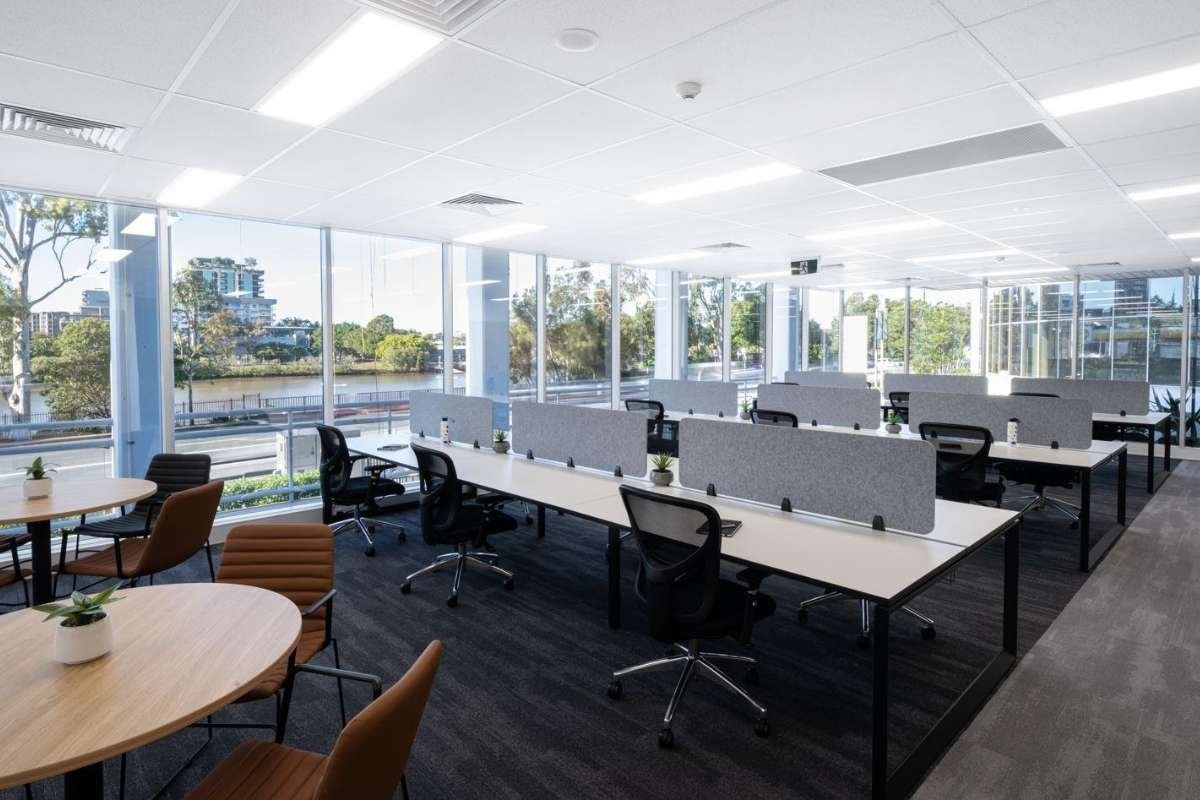
Businesses are shrinking their overall office footprints, but they are spending much more money on premium spaces. This specific trend heavily shapes the modern Commercial Real Estate Market NYC.
Modern businesses require high-end workplaces to convince employees to leave their comfortable home couches. Look at JPMorgan Chase’s brand-new global headquarters at 270 Park Avenue. This giant skyscraper runs entirely on electricity. It produces zero net operational emissions, uses advanced air filters, and tracks environmental data with 100,000 smart sensors.
This creates two entirely different realities for landlords. Real estate professionals call a top-tier building like this a “Class A” or “Trophy” property. Think of it as the newest iPhone on the market. Older, unimproved buildings are “Class B” or “Class C” properties—the old flip phones of the city.
Class A asking rents in Manhattan rose to an average of $83.25 per square foot. Meanwhile, premium buildings near Penn Station pushed regional averages up to $86.57 per square foot. Owners of flip-phone buildings must drop their prices or convert their properties into residential apartments.
How Are Luxury Brands Reshaping Manhattan’s Retail Districts?
Retail spaces are injecting incredible energy back into the Commercial Real Estate Market NYC. According to the latest REBNY H1 2026 Manhattan Retail Report, quality storefront availability fell by more than 20% over the past two years in elite areas. Corridors like SoHo and Upper Fifth Avenue have almost no premium vacancies left.
Seventeen new stores and restaurants opened on Madison Avenue in the first half of 2026 alone. Instead of signing traditional leases, mega-brands like Rolex, Prada, and Kering are buying their buildings completely. Buying protects these companies from future rent spikes. It also guarantees them a permanent spot on the world’s most famous shopping streets.
High foot traffic near major transit stations keeps retail revenues remarkably high. Fred Cerullo, President and CEO of the Grand Central Partnership, tracks this local foot traffic closely:
“Lower Fifth Avenue holds some of the most popular retail addresses in Manhattan. Our pedestrian data tells a clear story. Foot traffic along Lower Fifth Avenue grew 2% in the first half of 2026 compared to last year.”
What is the “Obsolescence Gap” Driving the Real Estate Divide?
Most news outlets look at the overall 19.9% office vacancy rate and claim that New York City faces a real estate crisis. However, this surface-level analysis misses the true mechanism driving the Commercial Real Estate Market NYC. Industry insiders call this hidden dynamic the Obsolescence Gap.
The market does not suffer from a lack of tenant demand. Instead, it suffers from a massive mismatch in building utility. If you remove the older buildings that lack modern air filters, tech integration, and fitness amenities, the vacancy rate for modern spaces drops significantly. Top-tier, well-connected properties actually face a severe supply shortage.
Where Are Billion-Dollar Institutional Investors Placing Their Capital?
Mega-rich institutional buyers are still spending historic sums of money on New York infrastructure. They view the Commercial Real Estate Market NYC as a safe piggy bank to protect and grow global wealth.
- One Vanderbilt Avenue: A minority stake sale in One Vanderbilt Avenue valued the office tower at $4.7 billion. This pricing breaks down to a staggering $2,712 per square foot.
- 1345 Avenue of the Americas: Similarly, a stake transfer at 1345 Avenue of the Americas valued that property at $1.4 billion.
These multi-billion-dollar deals confirm that major financial institutions maintain massive long-term confidence in New York’s primary business districts.
Step-by-Step Checklist: How Do Professionals Underwrite Modern NYC Properties?
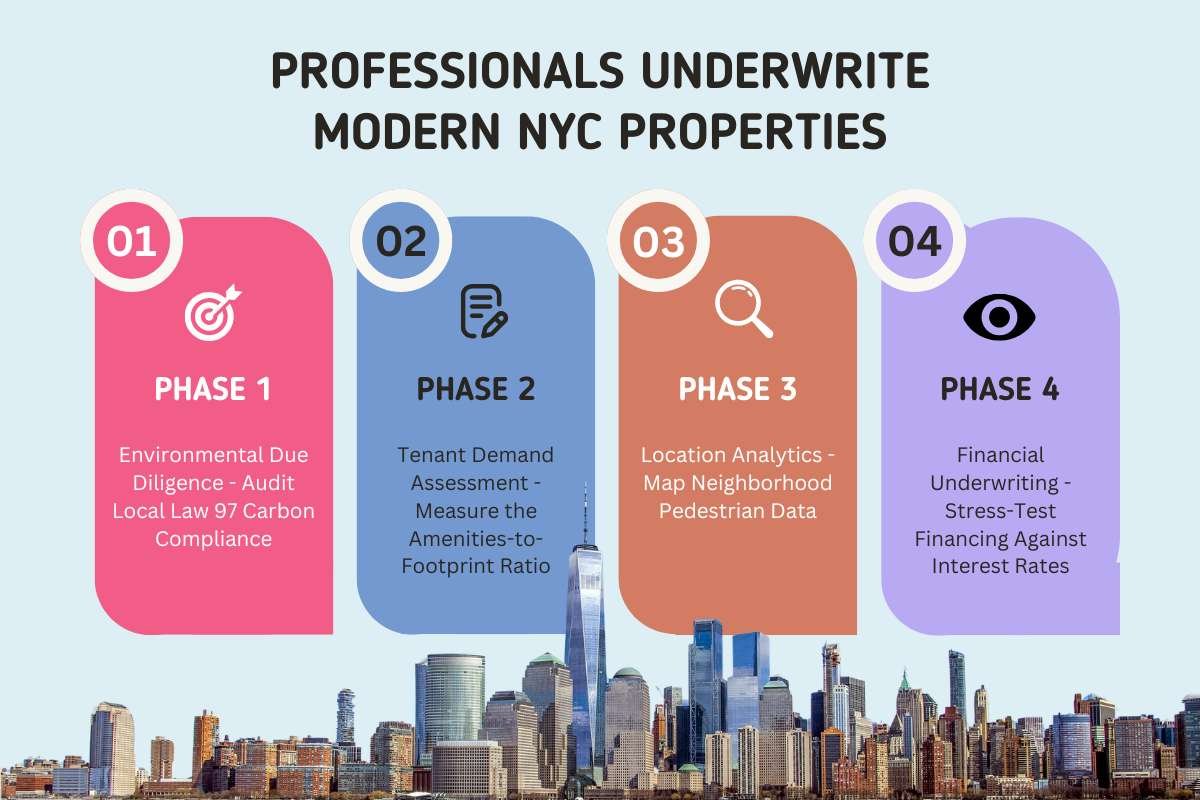
Buying property in New York requires a strict assessment process. Real estate pros call this process “underwriting.” Think of underwriting as doing your homework and double-checking all the math before you spend your allowance on something huge.
Phase 1: Environmental Due Diligence – Audit Local Law 97 Carbon Compliance
Review the building’s energy footprint. New York City charges severe cash penalties to property owners who miss carbon reduction targets. Calculate the cost of replacing old heating systems with modern all-electric designs.
Phase 2: Tenant Demand Assessment – Measure the Amenities-to-Footprint Ratio
Calculate how much square footage the building gives to shared tenant experiences. Modern corporate tenants demand outdoor terraces, wellness rooms, and top-tier gyms. If the property lacks these spaces, subtract the construction cost from your purchase offer.
Phase 3: Location Analytics – Map Neighborhood Pedestrian Data
Gather direct foot traffic counts from local Business Improvement Districts. Properties near major transportation hubs like Grand Central Station or Penn Station maintain higher occupancy rates over time.
Phase 4: Financial Underwriting – Stress-Test Financing Against Interest Rates
Model your mortgage payments against the Federal Reserve’s current financial policies. Factor in higher costs for building materials and construction labor to ensure the property makes a net profit.
FAQs
1. What does net absorption mean in real estate reports?
Think of a classroom. If 10 new kids join the class and 3 kids leave, you have a “net gain” of 7 students. In real estate, net absorption measures the change in occupied commercial space. Positive absorption means companies are moving into offices much faster than they are leaving them.
2. What is a basis point change in vacancy metrics?
A basis point is just a single penny of a percentage point (0.01%). Real estate professionals use this tiny unit to track small market shifts accurately. For example, when Brooklyn’s office vacancy rate dropped by 360 basis points, it meant the vacancy rate fell by exactly 3.6%.
3. Why does the outer borough industrial market remain so strong?
Logistics firms and e-commerce brands need warehouse space close to dense neighborhoods for fast deliveries. This demand keeps the industrial vacancy rate on Long Island at a low 5.2%, giving landlords great pricing power.
4. What is the average office rent in the Commercial Real Estate Market NYC?
The overall office asking rent across Manhattan stands at $73.13 per square foot. However, Class A space averages $83.25 per square foot, and elite trophy spaces in Midtown routinely command between $200 and $300 per square foot.
Conclusion: The Path Forward for Investors
The New York commercial real estate market rewards operators who adapt to modern workforce expectations. The latest data shows that the city’s commercial core is stabilizing after years of massive structural changes. By focusing your capital on sustainable, highly connected, and amenity-rich spaces, you put your portfolio in a prime position to capture long-term growth in the world’s most resilient financial center.